



ERP systems, payment platforms, third-party master data repositories, BI tools, banking platforms, and operational business systems: everything must communicate in real time.
With its secure REST API, Datalog TMS takes a decisive step forward—enabling Group Treasury teams to break out of silos and transforming the Treasury Management System from a standalone management tool into a fully interconnected financial platform, capable of orchestrating flows, data, and decision-making across the enterprise.
A Simple, Robust, and Secure Architecture — A Structured Response to Payment Fraud
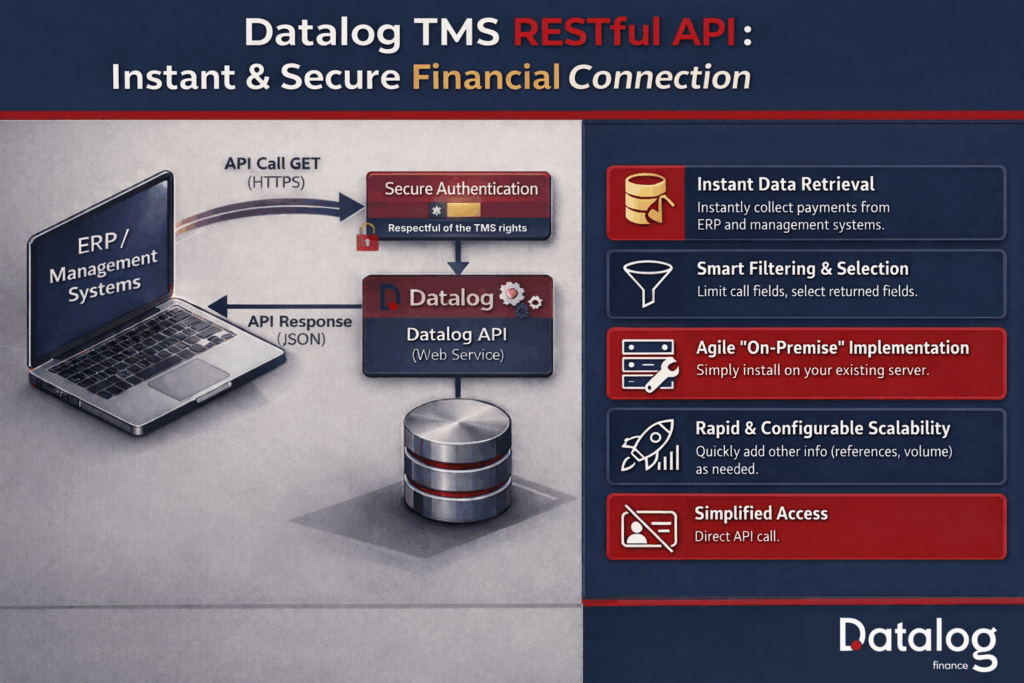
The Datalog TMS API is built on a clear and secure framework:
-
HTTPS calls (GET)
-
Secure authentication fully aligned with TMS user rights (action permissions, entity-level access, viewing rights, etc.)
-
Structured JSON responses
-
Immediate processing within the ERP or any third-party system
Result: instant and secure financial connectivity—no manual data extraction, no Excel reprocessing, no operational latency.
Tangible Benefits for the Treasury Function
1. Instant Data Retrieval
The API enables real-time retrieval into the ERP or any upstream accounting or management system of:
- Payment or batch execution statuses from the Payment Factory, to track workflow progress (including rejections and associated reasons)
- Payments, for real-time reconciliation in upstream systems against transactions recorded in the TMS
- Batch and payment history for consolidation purposes
- Manually created payments in the TMS, instantly fed back into the ERP or accounting system
👉 Eliminates manual exports
👉 Accelerates consolidation processes
Productivity impact:
- Shorter closing cycles
- Automatic cash position updates
- Real-time ERP ↔ TMS synchronization
2. Intelligent Data Filtering
The API allows precise selection of:
- Required data fields
- Defined organizational scopes
- Specific transaction types
- Selected time periods
Users retrieve only what is strictly necessary.
Productivity impact:
- Reduced data overload
- Lighter, more efficient integrations
- Improved flow performance
3. Agile Implementation — Including On-Premise Environments
This web service is straightforward to deploy on existing servers, enabling two main scenarios:
- Seamless integration into an existing IT landscape
- Connection to internal tools (BI, RPA, data lakes)
Productivity impact:
- Fast deployment
- No heavy IT projects
- Full alignment with group security requirements
4. Fast and Configurable Scalability
New data types are continuously added in successive releases, including:
- Bank statements
- Third-party master data
- Enriched status information
- Analytical datasets
This ensures the API evolves alongside:
- Group expansion
- Regulatory requirements
- Emerging data-driven use cases

Use Cases
1. Automatic ERP Payment Synchronization
An ERP system initiates supplier payments.
The API automatically retrieves:
- The bank execution status
- The transaction reference number
- The actual execution date
👉 Elimination of manual reconciliations
👉 Reduction of status errors
👉 Time savings for the accounting team
2. Intelligent RPA for Reconciliation
An RPA bot queries the API to:
- Identify rejected payments
- Retrieve error codes
- Automatically generate tickets
👉 Reduced manual processing
👉 Improved resolution rates
👉 Fewer internal escalations
3. Feeding a Finance Data Lake
TMS payment data can be automatically injected into a data environment to support:
- Forecast vs. actual analysis
- Multi-year historical tracking
- Behavioral analysis of cash flows
👉 Improved forecast accuracy
👉 Stronger strategic cash management
Strategic Opportunities Enabled by API-Driven Integration
The API is not merely a technical connector.
It repositions the TMS as a central financial hub.
1. Towards Real-Time Treasury
With the API, an increasingly proactive treasury function can envision:
- Dynamic alerts based on liquidity thresholds
- Automated cash pooling arbitrage
- Automated short-term financing triggers
This paves the way for more secure and intelligent payment management.
2. Advanced Automation (AI / Machine Learning)
With a standardized, structured JSON data flow:
- Cash flow anomaly detection
- Liquidity stress prediction
- Automatic position optimization
The API becomes the technical foundation of an augmented treasury function—and a powerful anti-fraud lever.
3. Partner Ecosystem
While Datalog TMS provides an API to retrieve and push data into other systems, it also enables seamless connectivity to third-party APIs without complex configuration, including:
- Specialized fintech integrations
- ESG / CSR reporting tools
- Trade finance solutions
- Automated hedging platforms
The TMS thus evolves into an open platform within a broader financial ecosystem.

TMS APIs: A Must-Have for Group Treasurers?
The Datalog TMS RESTful API is not just a web service.
It is a transformation accelerator for the Group Treasury function.
It delivers:
- Real-time capabilities
- Security
- Scalability
- Measurable productivity gains
Above all, it lays the foundation for a treasury function that is:
- Connected
- Automated
- Data-driven
- Predictive
With liquidity management and risk control at the core of corporate strategy, equipping a TMS with real-time connectivity to the financial ecosystem represents a decisive competitive advantage.