




AI in treasury management is fundamentally reshaping the corporate treasurer’s role. Machine learning-powered forecasts, automated bank reconciliation, real-time fraud detection, agentic assistants capable of orchestrating end-to-end processes: use cases are multiplying, and early field experience is starting to crystallize into a real playbook.
But behind the technology promise, the reality on the ground is more nuanced. Without clean data, clear governance and a dedicated business owner, even the best AI model will fall flat. This article unpacks the structural trends, six deployable use cases, the concrete transformation of the treasurer’s day-to-day, and the conditions for a successful AI treasury project.
The TMS market in transformation
Four dynamics are reshaping treasury management systems in the AI era.
AI & MACHINE LEARNING
Cash flow forecasting, real-time fraud detection and predictive analytics. Over 40% of companies report meaningful efficiency gains.
GENERATIVE AI
Query your TMS in plain English, get proactive recommendations and generate narrative reporting on the fly.
AGENTIC AI ASSISTANT
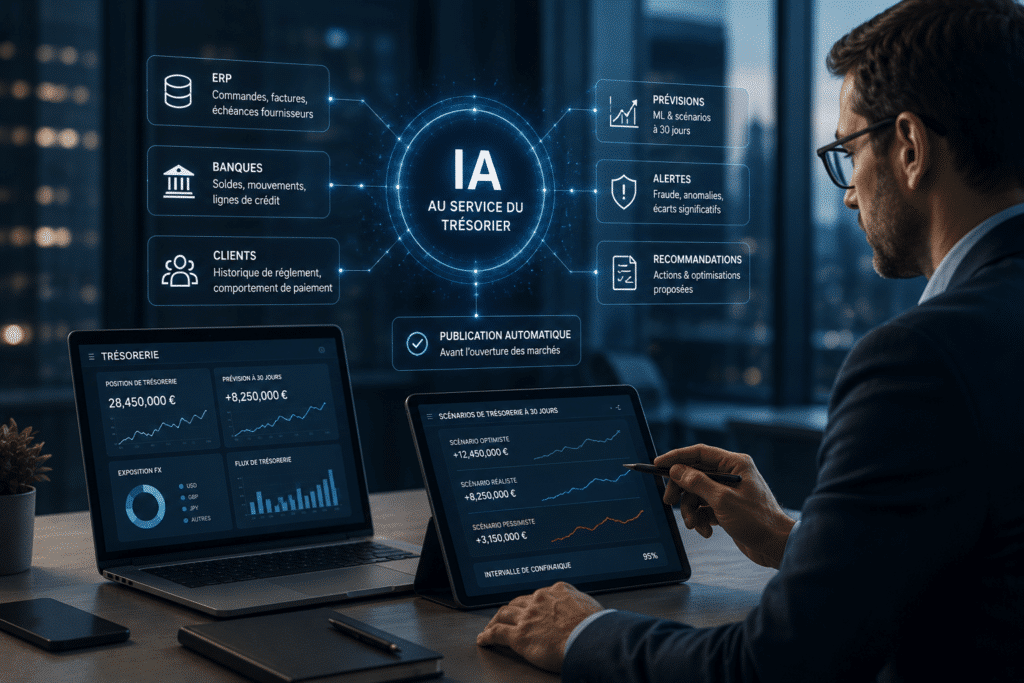
Orchestrates an end-to-end process: data collection, consolidation, scenarios, forecasts and alerts before markets open.
INTEROPERABILITY & AUTOMATION
Smart connectors, APIs, AI-assisted code: faster, more reliable and better-governed flows.
The agentic assistant: the decade’s biggest leap for AI in treasury management
Where the other trends automate isolated tasks, the agentic AI assistant orchestrates an entire process from end to end, with no human intervention on the operational side.
In practice, every night the assistant can automatically consolidate data from multiple sources: ERP feeds (confirmed orders, issued invoices, supplier due dates), real-time bank data (balances, intraday movements, available credit lines) and customer payment history segmented by behavior. It generates three scenarios — best case, base case, worst case — with explicit confidence intervals, and publishes the 30-day forecast in the TMS before markets open.
The treasurer is no longer involved in producing the forecast. Their role narrows to three precise touchpoints: validating exceptional assumptions the agent flags itself (an ongoing acquisition, a customer in financial distress, a non-recurring large outflow), adjusting treasury policy parameters when the macro environment requires it, and making the investment or financing decisions the agent recommends but cannot execute on its own.
The emerging model: AI produces, humans supervise and decide. Already operational at several large groups, with sharply reduced forecast variance, fewer manual errors, and teams refocused on analysis and decision-making.
AI in treasury management: amplifier, not replacement
The reality on the ground is more nuanced than the theory. According to the EY Global DNA of the Treasurer study from September 2025, two figures capture the current maturity of AI in treasury management:
of treasurers expect AI management to become a growing part of their role over the next 5 years.
still don’t have reliable cash forecasts at 12 months.
The revolution will be methodological first (data quality, governance, process maturity) and only then technological. The real question isn’t “should we do AI or not?” but rather “are we actually ready for AI in treasury management?”
The Association for Financial Professionals (AFP) and the Association of Corporate Treasurers (ACT) agree on this point in their recent publications: AI project maturity depends far more on data preparation than on the choice of technology.
NON-NEGOTIABLE PREREQUISITE
Without upfront, structured centralization of data flows (ERP, banks, TMS, spreadsheets), AI has nothing to work with — no matter how sophisticated the model.
Six AI use cases in treasury management
These six use cases of AI in treasury management don’t all require the same level of preparation. Some can be deployed in a few weeks with existing tools; others assume 12 to 18 months of upfront work on data quality and systems architecture.
Detailed use case: ML-augmented cash forecasting
Today’s situation. Manual collection of invoicing data from the ERP, weekly chasing of business units for their inflow forecasts, consolidation in Excel, arbitration between conflicting assumptions. Output is often inaccurate and delivered with a 2- to 3-day lag.
Operational method. Phase 1: audit and clean historical data (ERP, banks, TMS). Phase 2: visualize seasonality and key correlations. Phase 3: build the ML model on a narrow scope (one BU, one flow). Phase 4: appoint a business owner responsible for correcting model drift. It’s one of the highest-ROI starting points for AI in treasury management.
Detailed use case: payment fraud detection
Today’s situation. Manual verification of bank details, authorization limit checks, paper or email-based dual signatures, transmission via banking portals. The process is linear and vulnerable to wire transfer fraud (BEC), which has surged since 2022.
Operational method. Each payment order is scored by AI (beneficiary consistency, amount, channel, user behavior vs. history). Compliant payments are pre-approved; anomalies trigger a multi-signature workflow. The score is computed in real time, where a human check takes 5 to 10 minutes and remains exposed to error or social engineering.
The treasurer’s typical day: before / after AI in treasury management
The most telling contrast in the AI treasury transformation hides in the detail of daily tasks. What changes isn’t just the time spent on each activity — it’s the very nature of the work expected from the treasurer.
Success factors and key risks
The fundamental prerequisite: data before algorithm
The golden rule, confirmed by every field experience with AI in treasury management: without structured, centralized and reliable data, even the best AI model is doomed to fail. The invariant sequence of successful projects breaks down into five steps.
Audit
Assess the quality of existing data (ERP, TMS, banks, local spreadsheets).
Centralization
Govern data flows in a data lake or directly inside the TMS.
Visualization
Have business teams validate the data before any algorithmic work.
Targeted PoC
Narrow scope with a clearly identified business owner accountable for the model.
Measure and scale
Track results, correct biases, and roll out gradually to other scopes.
What doesn’t change: human judgment
The transformation doesn’t remove the treasurer’s responsibility — it shifts it. Three areas will remain firmly under human control:
FX and financing decisions
Legal and strategic accountability stays with the treasurer. AI proposes, but doesn’t decide.
Banking relationships
Trust, negotiation and long-term context — inherently human territory.
Exceptional signals
Geopolitical crisis, acquisition, unprecedented disruption: AI trained on history can’t see these coming.
Key takeaway: AI in treasury management in 2026
AI in treasury management is a real, measurable transformation that’s already underway at the most advanced organizations. But it doesn’t follow the script of a fast technology switchover after a tool installation.
It’s first a transformation of the relationship with data. Then a transformation of processes. And only then a transformation of technology. The companies that have started this work began with a defined scope, clear governance, and a business owner accountable for the models.
Tomorrow’s treasurer won’t be replaced by AI. They’ll be the one who knows how to steer it, audit it, and direct it toward the right strategic decisions. The emerging key skill isn’t technical — it’s the ability to define what AI should optimize for, to spot when it drifts, and to make the final call with judgment.
AI in treasury management is an amplifier, not a replacement. It cuts down analysis time and low-value tasks, freeing the treasurer to focus on what matters: judgment, relationships and strategy.
Also on our blog:
Want to explore how AI in treasury management can transform your finance department?
→ Request a Datalog TMS demo